

Authored by Ronan Sanzone and Ethan Wong
Summer interns from Malden Catholic High School
Over the last few years, investing has shifted in ways previous generations never imagined. Generation Z, born between the mid-1990s and early 2010s, is at the very center of this shift². Gen Z is redefining what it means to invest, not only in financial markets but also in culture and technology². With social media influence, crypto enthusiasm, and an emphasis on trends, this generation is leaving a notable mark on the world of finance¹.
Social Media’s Influence
Unlike Baby Boomers or even Millennials, Gen Z doesn’t primarily learn about investing from newspapers, traditional advisors, or even formal education². Instead, they’re on TikTok, YouTube, and Reddit⁴. Platforms like these amplify both information and misinformation at lightning speed⁴. Viral trends, like the GameStop short squeeze⁶, highlight how online communities can move markets in ways unimaginable a decade ago⁶. While this makes investing more accessible, it also exposes Gen Z to greater risks since social media-driven decisions often lack careful research¹.
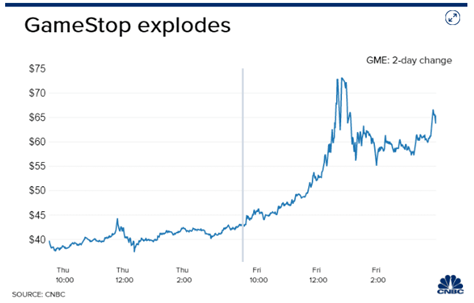
GME as of Friday, January 22, 2021. Source: CNBC. For informational purposes only, GameStop short squeeze January 2021
Crypto and Risk-Taking*
Cryptocurrency has become one of the main avenues for Gen Z investors¹. More than half of Gen Z adults between the ages of 18 and 25 have already dipped into investments¹. Crypto appeals because it’s fast-moving, trendy, and feels like being part of a cultural shift¹. However, its volatility means these investments often prioritize excitement over stability⁵. For many Gen Zers, being “early” in crypto or NFTs is less about long-term security and more about proving they can spot trends before others¹.
*This is intended strictly for educational purposes and is not a recommendation for or against cryptocurrency
Is it Laziness or Efficiency?
Older generations may see Gen Z as lazy, but much of their behavior stems from efficiency¹. Instead of traditional investing research, Gen Z prefers quick insights from influencers or apps⁴. They don’t want the hassle of managing dozens of accounts or reading long financial reports¹. This doesn’t necessarily mean they care less; it often means they’re optimizing for speed and convenience in a fast-paced world¹.
Social Expectations and Trends
For Gen Z, investing isn’t only about making money¹. It’s also about identity¹. They want to be trendsetters who discover brands, products, and companies before they blow up³. Just as they subscribe to streaming services rather than buying individual movies³, they favor experiences over material possessions³. Owning stock in a startup, following a brand from its early stages, or jumping into viral coins reflect both their social identity and financial goals¹,⁵. Being able to say “I was there first” matters as much as the returns themselves¹.
- Be the first to “discover” the next big crypto or startup
- Show they have an eye for potential before something goes mainstream³
- Be part of the conversation and the culture around investing³
A Generation in Transition
This shift is happening at the same time as “the great retirement,” where Baby Boomers are leaving the workforce and passing down companies, wealth, and opportunities². Gen Z is stepping into this vacuum with entirely different priorities than their predecessors². Unlike Baby Boomers, who focused on long-term stability², or Millennials, who embraced tech while balancing caution², Gen Z is fast, experimental, and socially connected in nearly every financial decision¹.
- They support brands with a mission they believe in³
- They prefer subscription services and access over ownership³
- They chase startups and early-stage companies they can grow with, not just profit from³
A New Era of Investing Influence
Gen Z is rewriting the rules of investing¹. Their approach blends social media culture, technology, and a desire for experiences with financial activity¹. They differ from Boomers’ patience and Millennials’ caution by valuing immediacy, identity, and trendspotting¹. While this comes with risk, it also shows that the future of investing will be more interconnected with culture than ever before¹. The question is: will this approach lead to sustainable wealth or just fleeting financial fads¹?
This material is intended for informational/educational purposes only and should not be construed as investment advice, a solicitation, or a recommendation to buy or sell any security or investment product. Investments are subject to risk, including loss of principal. Some investments are not suitable for all investors, and there is no guarantee that any investing goal will be met. Past performance is no guarantee of future results. Please contact your financial professional for more information specific to your situation.
Sources
¹4 surprising ways gen z is investing differently than older generations. (n.d.). Investopedia. Retrieved July 15, 2025, from https://www.investopedia.com/gen-z-investing-trends-8782299
²What is gen z? | mckinsey. (n.d.). Retrieved July 15, 2025, from https://www.mckinsey.com/featured-insights/mckinsey-explainers/what-is-gen-z
Financial services trends for gen z and what that means for financial pros. (n.d.). Retrieved July 15, 2025, from https://www.lexisnexis.com/community/insights/professional/b/industry-insights/posts/gen-z-investing-habits
³Casperson, N. (n.d.). How the future of tiktok may impact a generation’s financial literacy. Forbes. Retrieved July 18, 2025, from https://www.forbes.com/sites/nicolecasperson/2023/03/27/why-the-future-of-tiktok-impacts-the-fintech-industry/
⁴read, O. G. 1 min. (2025, July 18). Dogecoin open futures bets surge to record 16b doge as prices top downtrend line. Yahoo Finance. https://www.coindesk.com/markets/2025/07/18/dogecoin-open-futures-bets-surge-to-record-16b-doge-as-prices-top-downtrend-line
(N.d.). Retrieved July 18, 2025, from https://www.cato.org/cato-journal/fall-2021/gamestop-episode-what-happened-what-does-it-mean